|
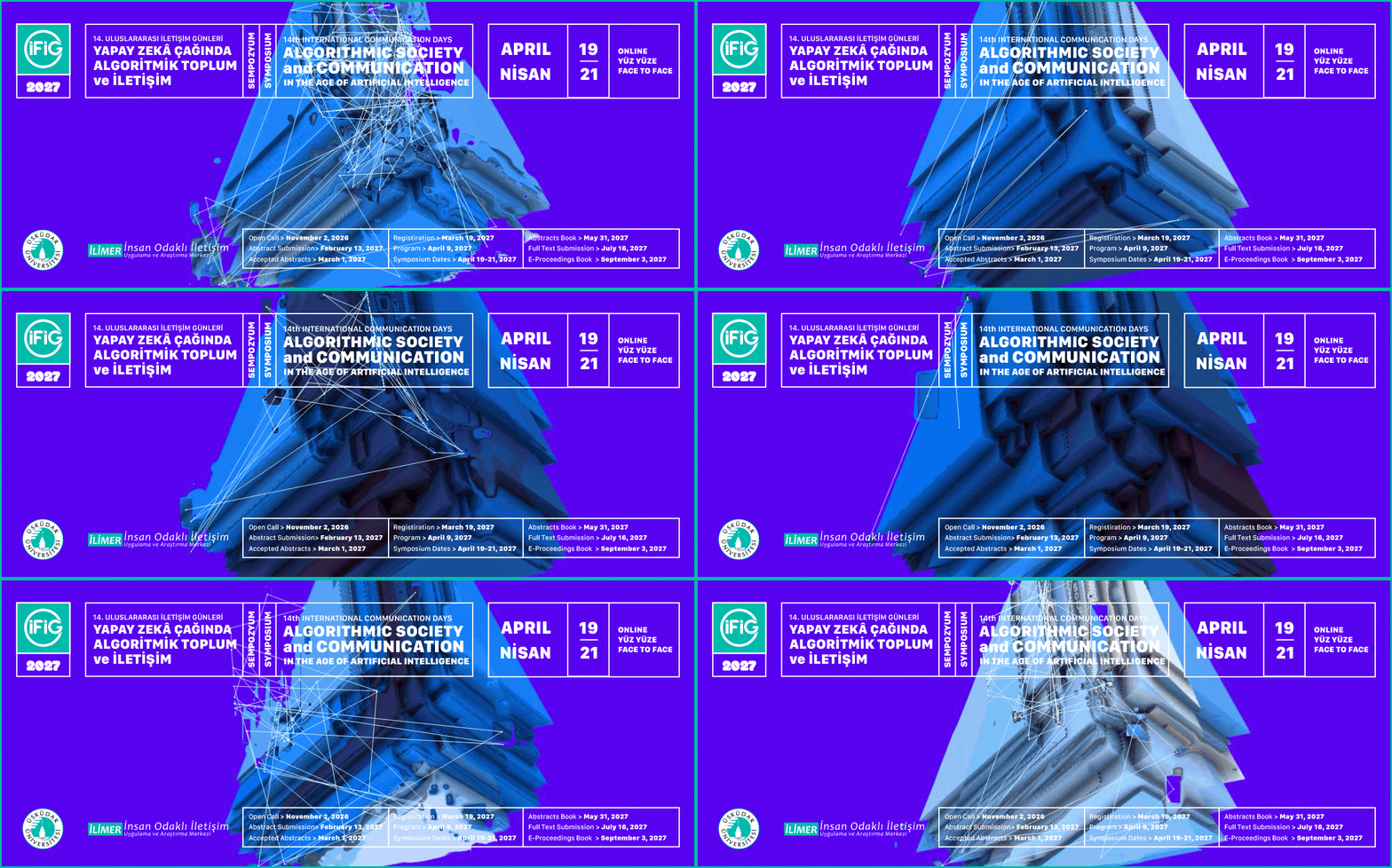
The 14th International Communication Days Symposium, organized by the Faculty of Communication at Üsküdar University, will take place on 19–21 April 2027 at Üsküdar University, in partnership with the Communication University of China, under the theme Algorithmic Society and Communication in the Age of Artificial Intelligence. Following our collaborations with Baku State University in Azerbaijan in 2025 and Near East University in the Turkish Republic of Northern Cyprus in 2026, International Communication Days returns home this time with renewed strength. The 14th International Communication Days Symposium aims to explore the technological, social, cultural, economic, ethical, and political dimensions of artificial intelligence in the field of communication from an interdisciplinary perspective. We are living in an era of accelerating digital transformation, in which artificial intelligence technologies are penetrating an increasing number of areas of social life. Algorithms have become so deeply embedded in our everyday lives that they can no longer be regarded merely as technical tools. They organize our news feeds, determine which content becomes visible, participate in processes of cultural production, influence our consumption habits, and transform the ways we interact in everyday life. These developments make it necessary to reconsider the boundaries, actors, and functioning of the field of communication. Alongside this transformation, the processes of communication production, circulation, and consumption are also changing significantly. AI-assisted content creation, algorithmic recommendation systems, chatbots, synthetic media, and deepfake technologies are bringing non-human actors into communication processes to an unprecedented extent. As a result, a new communication ecosystem is emerging in which the distinctions between the subject and object of communication are becoming increasingly blurred, and human–machine interactions are growing more intertwined. While this development brings the question of “What is communication?” back to the forefront, it also calls for a reconsideration of existing communication theories, concepts, and research methods. The rise of algorithms is also transforming the structure of the public sphere and the information ecosystem. Algorithms do not merely circulate information; they also influence what becomes visible or invisible, and what is considered important or unimportant. Therefore, the role of artificial intelligence and algorithmic systems in communication must be examined not only in terms of technological innovation but also in relation to power, representation, inequality, culture, and social structure. How is the public sphere being reshaped in an algorithmic society? Which actors are gaining power in the production and circulation of information? Which communities are represented, and which voices are becoming invisible? This discussion also encompasses how inequalities based on gender, age, ethnicity, and class are reproduced within algorithmic systems, as well as the ways children and young people engage with these systems. Within this context, media literacy and critical digital literacy are acquiring new significance in the age of artificial intelligence. Questions concerning whether content is produced by humans or machines, through which data and algorithmic processes information becomes visible, and how visual, audio, and textual content can be verified are becoming central areas of debate in communication studies. Accordingly, artificial intelligence is transforming not only the objects of inquiry within the discipline of communication but also the ways knowledge is produced and research is conducted. The rise of computational methods and the use of generative artificial intelligence in academic work are also giving rise to new debates concerning research ethics. The rise of artificial intelligence also calls for an examination of its implications in the contexts of platform capitalism, the data economy, and digital labor. The collection and processing of vast amounts of data, the growing influence of platforms on everyday life, and the increasing automation of communication processes raise new questions about relations of power and inequality. How AI systems are designed, what data they are trained on, and which values they reproduce have significant implications for representation, access, and participation in the field of communication. The implications of this transformation in Türkiye and the Global South, as well as the representation of local languages and cultures within AI systems, are also among the symposium’s areas of interest. The symposium aims to bring together academics, researchers, graduate students, and industry professionals to collectively reflect on the implications of algorithmic transformation for the field of communication. In addition to communication and media studies, the symposium welcomes contributions from sociology, psychology, political science, philosophy, law, computer science, cultural studies, and other disciplines. Alongside theoretical and empirical research, the symposium will also feature case studies, applied research, and creative projects. We invite all researchers to join us at Üsküdar University on 19–21 April 2027 for the 14th International Communication Days Symposium, to explore the transformation of communication in the age of artificial intelligence and to formulate new questions about the future of communication in an algorithmic society. |
||||||||||||||||||||||||||
|
|
||||||||||||||||||||||||||
|
The abstracts submitted for presentation will be subjected to rigorous evaluation by the distinguished panel of referees constituting the Symposium Scientific Committee. Accepted contributions shall be featured within the Symposium's Abstract Book, while comprehensive manuscripts will find their place in the electronically disseminated Symposium Proceedings Book. Regarding the submitted abstracts, a strict word limit of 250 words is enforced, while the accompanying full papers must adhere to a maximum word count of 7,500 words. Authors are strongly encouraged to meticulously adhere to the manuscript preparation guidelines delineated within the Üsküdar University Faculty of Communication Journal, Etkileşim, ensuring the highest standards of scholarly communication. The deadline for paper abstract submissions is February 13, 2027. All submissions must be made through the symposium's official website. Accepted papers will be announced by March 1, 2027. We eagerly await your papers and posters. We extend our gratitude in advance for your valuable contributions. Hoping to meet in Istanbul. |
DAVETLİ KONUŞMACILAR

Prof. Dan Schiller FROM TELEGRAPH TO AI: DOMINATION AND RESISTANCE IN TELECOMMUNICATION

Prof. Dr. José van Dijck DIGITAL SOVEREIGNTY FOR EUROPE IN THE ERA OF BIG TECH AND AI